

Column Styles Guide: Doric, Ionic, Tuscan & More
Most people can't tell a Doric column from an Ionic one — and that small knowledge gap causes real problems. It leads to replacement columns that clash with the rest of a home, missed opportunities to get the architecture right, and a lot of guesswork at the building-supply counter. This guide fixes that.
FiberglassColumns.com manufactures every major column order in fiberglass, from the plain Tuscan porch post to the leafy Corinthian capital. We work with these styles and this material every day, so we wrote the reference we wished existed.
What you'll learn
How to recognize the five classical column orders at a glance
The modern, non-classical column profiles on contemporary homes
A practical method to identify the column style you already have
How to choose the right style for your project
Why fiberglass has become the go-to material for architectural columns
The Five Classical Column Orders
The classical orders originated in ancient Greece and were later adapted by the Romans. Each order is a complete proportional system — it governs not just the look of the capital but the height, taper, and base of the whole column. Architects still use these same systems today, which is why knowing them helps you specify or match columns correctly.
Doric — the oldest and simplest
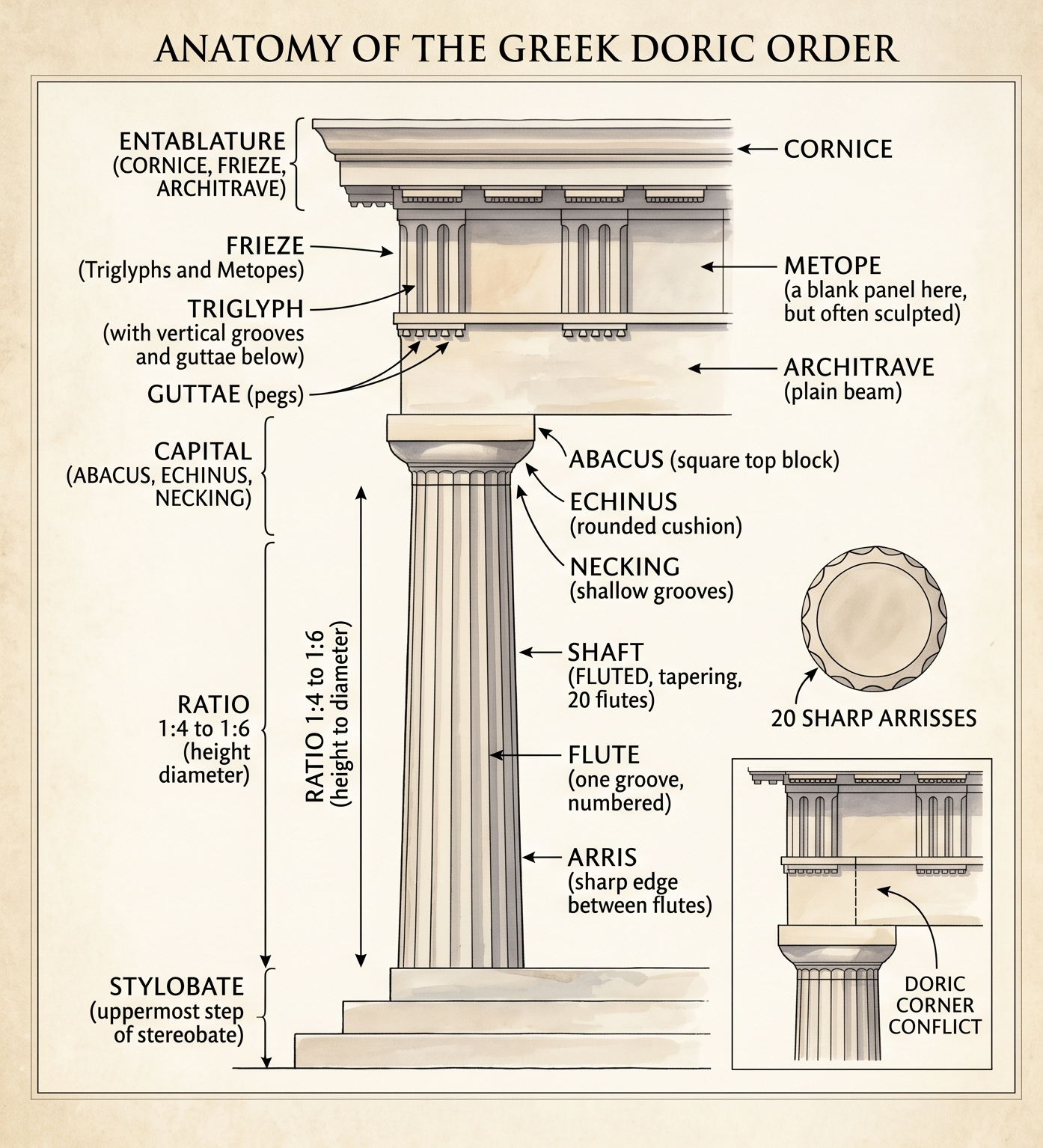
The Doric order is the earliest of the Greek orders, dating to roughly the 6th century BC, and it's the order used on the Parthenon. Its capital is the giveaway: a plain circular cushion (the echinus) topped by a square slab (the abacus), with no decoration. In the original Greek version the shaft sits directly on the floor with no base, though modern residential Doric columns almost always include one. Doric is also stout — its height-to-diameter ratio is roughly 6:1, making it shorter and heavier-looking than the orders that followed.
Doric reads as strength and solidity, which is why you see it on civic buildings, institutional architecture, and traditional homes that want a grounded, substantial look. FiberglassColumns.com offers round Doric columns in smooth and fluted finishes, tapered or straight shafts, in diameters from 6" up past 24".
Ionic — the scroll capital
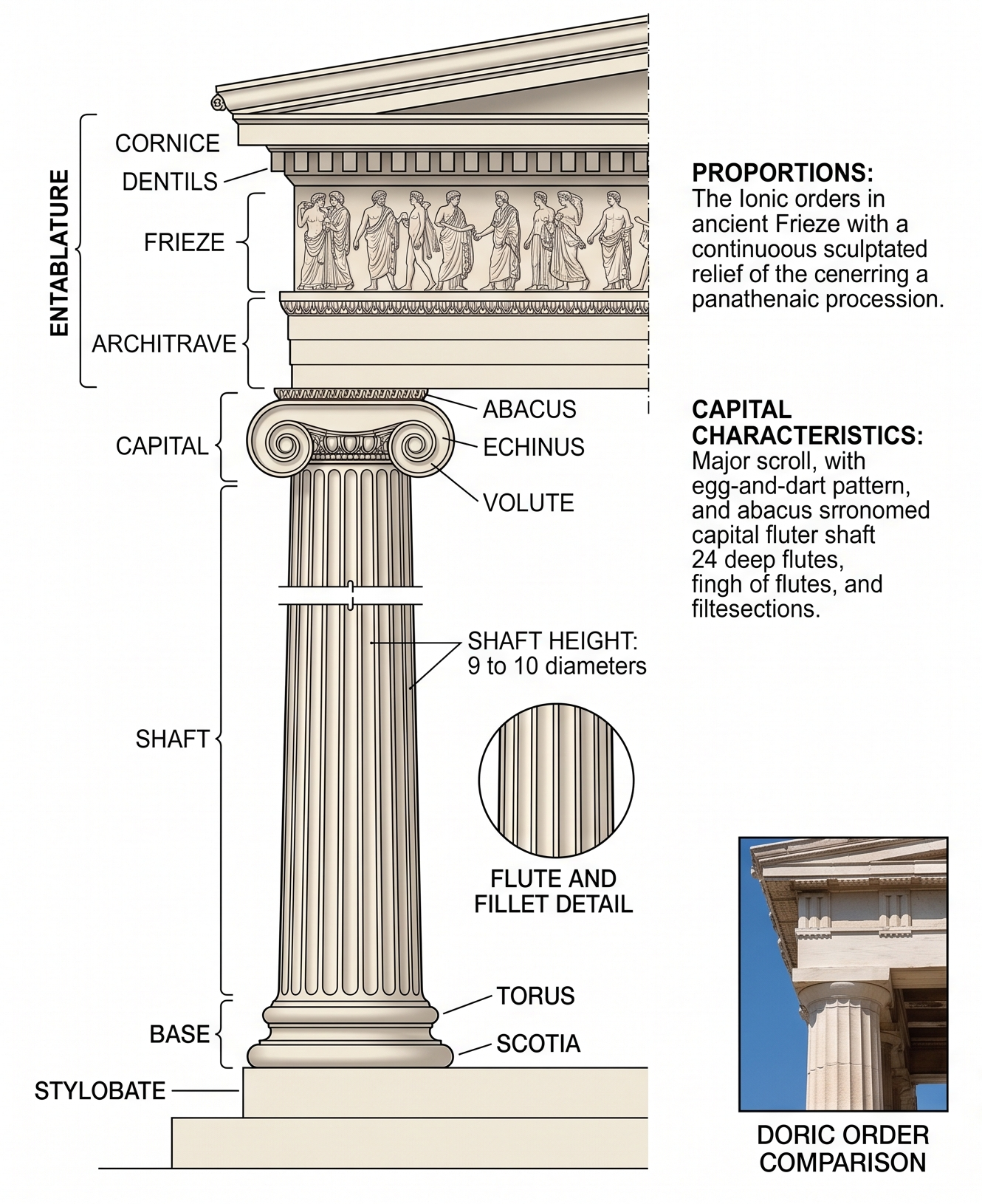
The Ionic order emerged in Ionia (western Turkey) around the 5th century BC and appears on the Erechtheion on the Athenian Acropolis. Its defining feature is impossible to miss: the volute, a pair of spiral scrolls that curl down from each side of the capital. The Ionic shaft is usually fluted with shallow vertical grooves and stands on a base with circular moldings. It's also more slender than Doric, with a height-to-diameter ratio of about 8:1.
Ionic conveys elegance with a clear historical reference. It's a natural fit for formal residential entries, academic buildings, and bank facades — anywhere you want refinement without going fully ornate.
Corinthian — the most ornate
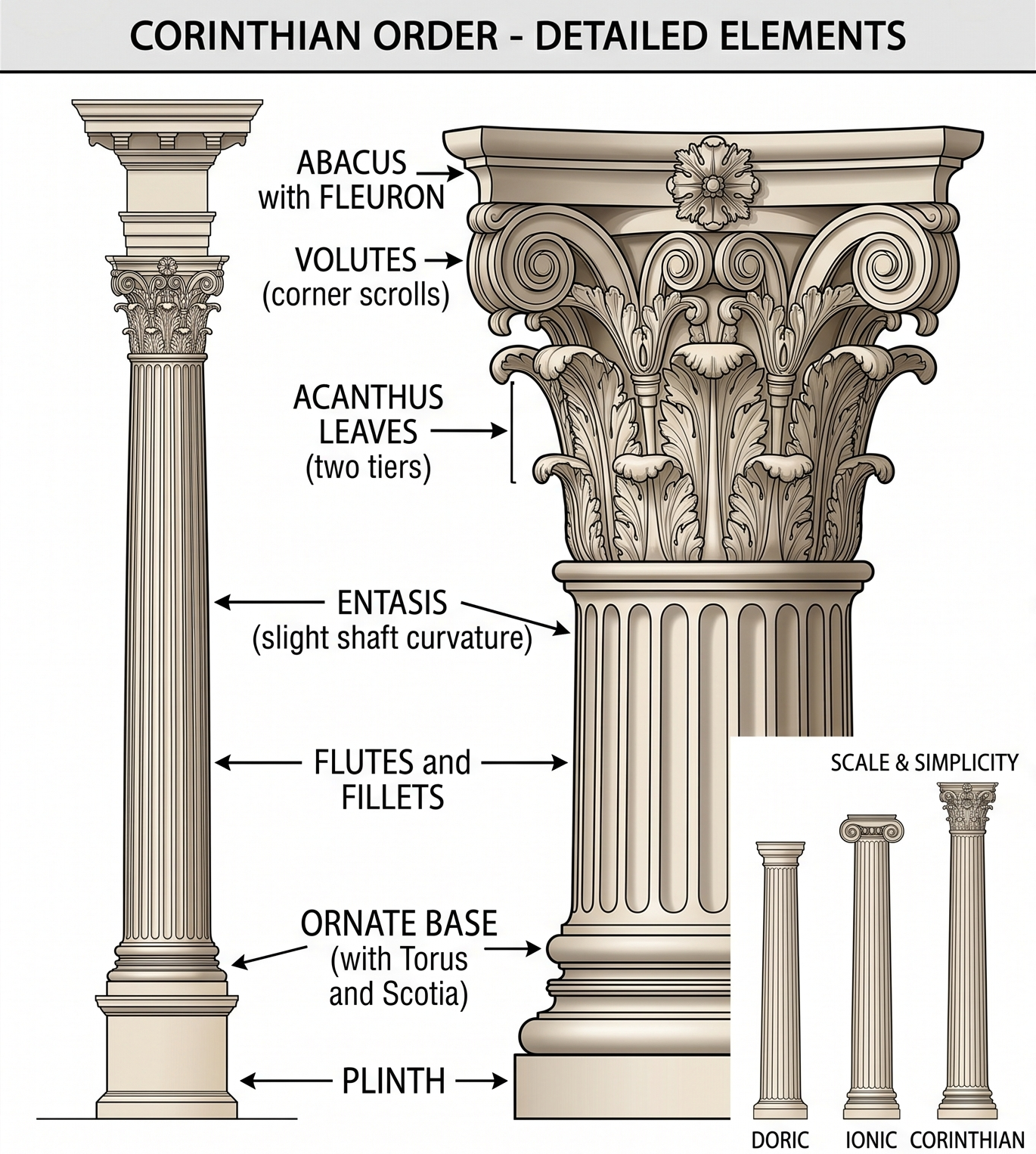
The most decorative of the classical orders, the Corinthian capital is a tall, bell-shaped form wrapped in carved acanthus leaves. It originated in Greece around the 5th century BC but became the signature of Roman monumental architecture. The shaft is typically fluted and sits on a base similar to the Ionic. It's the most slender order of all, with a height-to-diameter ratio of roughly 10:1.
Corinthian is the statement choice. It belongs in formal interiors, hotel lobbies, government buildings, and luxury residential projects where the columns are meant to be admired, not just to hold up a roof.
Tuscan — the Roman simplification
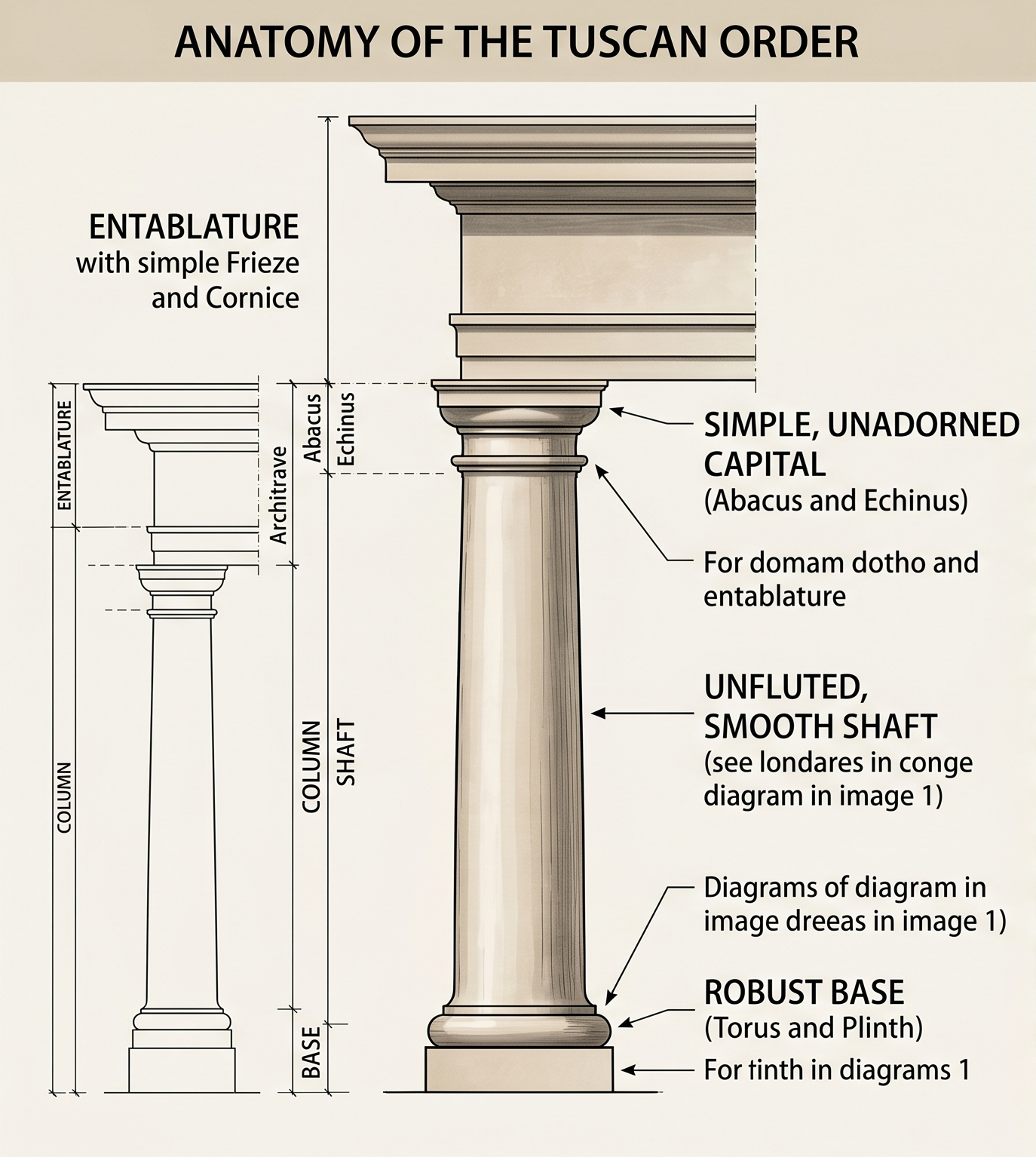
The Tuscan order is a Roman simplification of the Doric, named for the Tuscany region of Italy and codified as one of the five orders by the Renaissance architect Vignola. Its capital is even plainer than Doric — just a simple round molding and abacus, with no decoration. The shaft is always smooth (never fluted) and rests on a simple base.
This is the most popular column style for American homes by a wide margin. You'll find it on front porches, farmhouse exteriors, and craftsman houses everywhere. The smooth shaft is part of the appeal: it shows age and wear less than a fluted shaft and matches existing porch columns easily, which makes the Tuscan the go-to for renovations and replacements. If you're matching a colonial, farmhouse, or craftsman home, the Tuscan is almost certainly the style you want, and FiberglassColumns.com stocks it in the full range of sizes.
Composite — combining Ionic and Corinthian
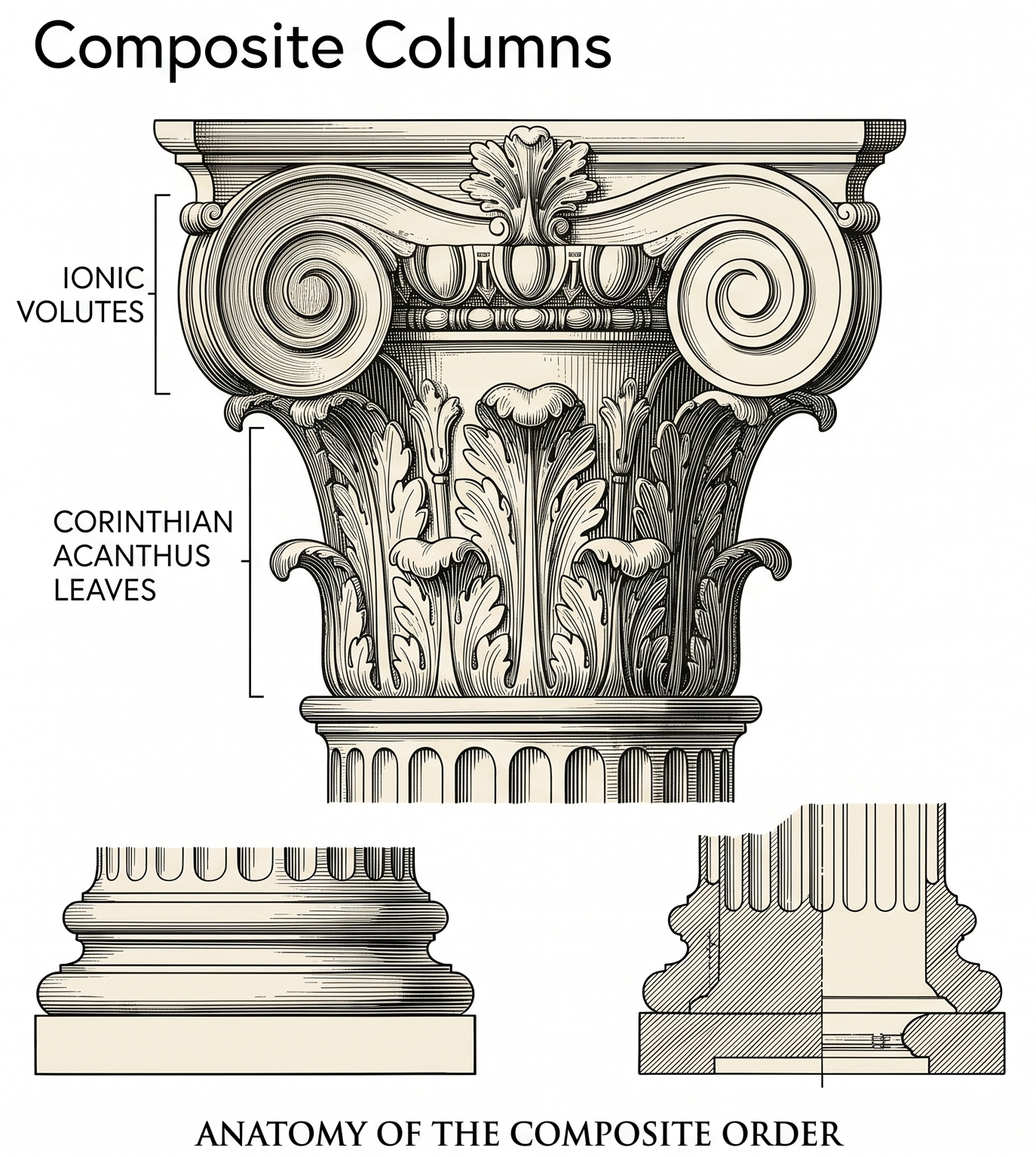
The Composite order is exactly what its name suggests: a Roman invention that merges the Ionic volute scrolls with the Corinthian acanthus-leaf capital. It's grand and richly detailed, used when a project calls for the full Corinthian effect with the added flourish of prominent scrolls. You'll see it on triumphal arches and other ceremonial Roman architecture, and it works today in the most formal civic and luxury settings.
Modern & Non-Classical Column Styles
Not every column follows a classical order. Modern architecture introduced clean-lined column profiles with no historical capital at all, prized for how they suit contemporary and transitional homes.
Square Columns
Square columns have a flat-sided profile instead of a round one. They suit craftsman, modern, and transitional architecture, and they're equally at home indoors framing an opening or outdoors supporting a porch roof. Many craftsman-style square columns taper from a wider base to a narrower top.

Round tapered (non-classical)
A round tapered column narrows gradually from bottom to top without committing to a specific classical capital. The taper gives it a traditional silhouette, but paired with a simple cap it reads as clean and versatile rather than period-specific.

Round Straight
A round straight column keeps the same diameter from base to capital. The uniform profile gives a more modern, geometric look and is often chosen for contemporary porches and interior applications.

Fluted vs. smooth shaft
Fluting refers to the vertical grooves cut into a column shaft. Fluted shafts (associated with Ionic and Corinthian) create shadow lines and a more formal, classical feel. Smooth shafts (associated with Tuscan and most modern columns) are cleaner, more casual, and easier to match in renovations. The choice is largely aesthetic — both are available across most styles.

Split / half columns (pilasters)
A pilaster is a column cut lengthwise so it sits flat against a wall, projecting only partway out. It reads as a column but functions as a decorative wall element. Pilasters are used to frame doorways and fireplaces, to echo freestanding columns elsewhere on a facade, and to wrap existing structural posts.

How to identify your existing column style
If you're trying to match or replace a column, you don't need to be an architect. Work through these four checks in order — the capital alone usually tells you most of what you need.
1. Look at the capital (the top).
This is the single most distinctive identifier. Plain round cushion with a square top and no decoration? Doric or Tuscan. Spiral scrolls? Ionic. Carved leaves? Corinthian. Scrolls and leaves together? Composite. A simple flat cap or no capital at all? Likely a modern or non-classical column.
2. Look at the base (the bottom).
Does the column sit on a molded base, or directly on the surface? Tuscan and most modern columns use a simple base; Ionic and Corinthian bases have more pronounced circular moldings.
3. Look at the shaft.
Run your eye down the column. Vertical grooves mean it's fluted (pointing toward Ionic or Corinthian). A clean, ungrooved surface means it's smooth (pointing toward Tuscan or modern). Note whether the shaft tapers or stays straight.
4. Check the proportions.
Classical orders follow set height-to-diameter ratios — roughly 6:1 for Doric, 8:1 for Ionic, and 10:1 for Corinthian. A short, heavy column leans Doric or Tuscan; a tall, slender one leans Ionic or Corinthian.
Choosing the right column style for your project
Once you can tell the styles apart, picking one comes down to a few practical questions.
Match the architecture
The column should speak the same language as the building. Tuscan and square columns suit farmhouse, colonial, and craftsman homes; Ionic and Corinthian suit formal and traditional designs; clean round or square profiles suit modern construction.
Formal vs. informal
The more ornate the order, the more formal the result. Corinthian and Composite read as ceremonial and grand. Doric and Tuscan read as solid and understated.
Interior vs. exterior
The more ornate the order, the more formal the result. Corinthian and Composite read as ceremonial and grand. Doric and Tuscan read as solid and understated.
When to mix styles
Generally keep one order throughout a single elevation or room so the design reads as intentional. Mixing works only when clearly deliberate — for example, a heavier order on a lower level and a lighter one above, which follows classical precedent.
Custom sizing
If a stock size doesn't fit your opening or load, FiberglassColumns.com produces custom-size columns in any style, so the right look never has to be compromised by the wrong dimensions.
Why fiberglass for architectural columns?
Fiberglass has become the default material for architectural columns for one reason: it lasts. Unlike wood, fiberglass won't rot, won't warp, and won't be eaten by insects, which makes it ideal for exposed porch and exterior applications where wood columns historically failed.
It's also low-maintenance and cost-effective. Fiberglass columns take paint readily and hold their finish without the annual sealing or repainting that wood demands. Compared with stone or real marble, they deliver the same architectural presence at a fraction of the weight and cost, and they install far more easily.
Best of all, fiberglass can be molded into every classical and modern profile in this guide — so you never have to trade the look you want for the durability you need.
Frequently Asked Questions
What are the five orders of classical architecture?
What are the five orders of classical architecture?
The five classical orders are Doric, Ionic, Corinthian, Tuscan, and Composite. The first three originated in ancient Greece; the Tuscan and Composite were defined by the Romans. Each is a complete proportional system, not just a capital design.
How do I tell the difference between Doric, Ionic, and Corinthian columns?
How do I tell the difference between Doric, Ionic, and Corinthian columns?
Look at the capital. Doric has a plain, undecorated cushion-and-slab top. Ionic has paired spiral scrolls called volutes. Corinthian has an elaborate capital covered in carved acanthus leaves. The capital is the fastest and most reliable way to tell them apart.
What is the most popular column style for homes?
What is the most popular column style for homes?
The Tuscan order is by far the most popular for American homes. Its smooth shaft and simple capital suit porches on farmhouse, colonial, and craftsman houses, and the plain profile is easy to match when replacing existing columns.
Can I get any column style in fiberglass?
Can I get any column style in fiberglass?
Yes. Every style in this guide — all five classical orders plus square, round, fluted, smooth, and pilaster profiles — is available in fiberglass, in both stock and custom sizes.
What's the difference between a column and a pilaster?
What's the difference between a column and a pilaster?
A column is freestanding and round (or square) on all sides. A pilaster is essentially a column cut in half lengthwise so it sits flat against a wall, projecting only partway out. Pilasters often frame doors and fireplaces or echo freestanding columns nearby.
Are round or square columns more traditional?
Are round or square columns more traditional?
Round columns are more traditional, since all the classical orders are round. Square columns are associated with craftsman, modern, and transitional architecture, though they appear in plenty of traditional settings too.
You now have what you need to identify any column on sight, match a replacement, or specify the right order for a new project: read the capital first, check the base and shaft, and let the building's architecture guide the choice. Whatever style fits, fiberglass lets you have it without the rot, maintenance, and cost that come with wood, stone, or marble.